Technology & AI
SPSS 2026 Update: The Next Chapter
By Bianca Welgraaf · · 9 min read
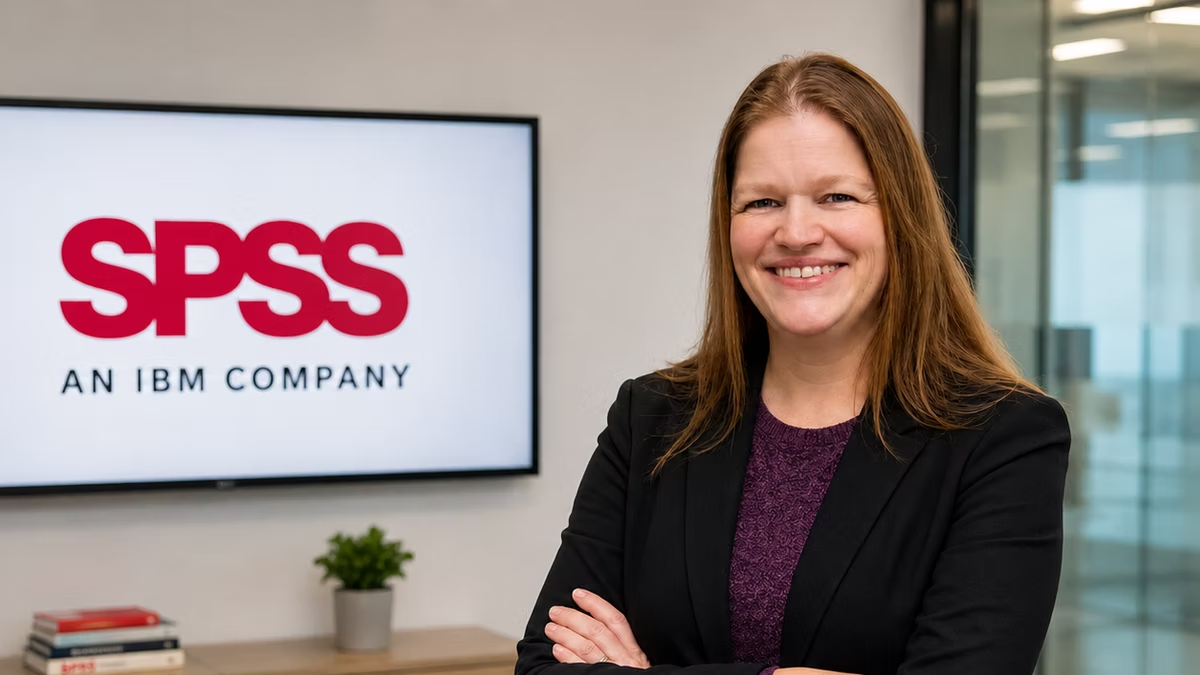
Many SPSS customers and partners have known me since 2012 as Bianca Welgraaf, the consultant, adviser and sales specialist behind SPSS licensing across the Benelux and Scandinavia.
I worked with SPSS at IBM from 2012 until 2019. In 2019, I joined Crayon, which is now part of SoftwareOne. I will leave Crayon on 30 September 2026.
I look back with great appreciation on my years at Crayon. I will particularly miss the excellent team with whom I worked for so many years.
Throughout this period, I worked on various software, cloud and business-development projects, but SPSS always remained an important part of my work.
IBM acquired SPSS in 2009. Much has changed since then. The product, its different licensing models and the ways in which organisations use SPSS have continued to evolve.
During this period, I increasingly specialised in IBM SPSS Statistics, licensing, pricing, contractual conditions, deployment and customer advisory services.
Training my colleagues on SPSS was one of the parts of my work I enjoyed most. It allowed me to expand my own knowledge while ultimately improving the experience and satisfaction of our customers.
Supporting thousands of SPSS customers
At Crayon, we tested and implemented SPSS in cloud environments. We also supported thousands of customers with their SPSS environments across the United States, DACH, Southern Europe, the UK and Ireland, the Benelux and the Nordic countries.
This involved much more than simply supplying a software licence.
Over the years, I combined several roles and responsibilities as a team leader, coach and later Head of Business Development. Our department consisted of more than 25 professionals and formed the international team within the organisation. I was personally responsible for leading a team of eight colleagues.
Although we worked on several software projects, SPSS was one of the most important parts of our activities.
Within the SPSS project, we were responsible for almost the entire commercial process, from strategy and customer engagement to sales, contracts and partner collaboration.
Our principal responsibilities included:
- SPSS sales advisory
- Account management
- Customer success
- Product specialisation
- Licensing advisory
- Pricing
- Quotations and contractual advice
- First-line support
- Presentations and demonstrations
- Partner management
- Advice on cloud and server environments
- Support-process optimisation
We also had a specialised team responsible for second- and third-line support, internal and external audits, product innovation, legal matters and process improvement.
This team worked closely with my team to ensure that the commercial, technical and operational activities were properly aligned.
At both IBM and Crayon, I was also closely involved with the partner channel.
We had daily contact with European partners, resellers and distributors. I regularly advised them on commercial opportunities, pricing and marketing activities, while also contributing ideas for improving our technical support.
A great deal of work also took place behind the scenes. For example, I was involved in translating and further developing manuals created by our technical support organisation.
Working with IBM and the partner network
Over the years, IBM established various partner agreements with companies such as Crayon. These agreements involved considerably more than sales.
We negotiated agreements and discounts, requested special pricing arrangements, evaluated pricing and searched for solutions to complex licensing situations.
At the same time, we worked with IBM and other European and international partners to improve the services surrounding SPSS.
This combination of IBM knowledge, partner experience, licensing expertise, pricing, contractual knowledge, customer advisory work and practical experience has given me a broad perspective on the SPSS market.
A new chapter
Following the acquisition of Crayon by SoftwareOne, my position was ultimately made redundant.
SoftwareOne already has an established IBM organisation, within which SPSS will also be incorporated. SPSS services will therefore remain available, but my own specialist SPSS role will come to an end.
Following constructive discussions, I decided to leave Crayon and SoftwareOne and consider my next professional step.
SPSS will, of course, remain an important part of that next step.
After seven years with Crayon and almost seven years with IBM before that, this feels like a logical moment to use my knowledge in a different way.
Do you have questions about your SPSS environment?
Later this year, I will continue as an independent adviser and will be available to help organisations with questions relating to SPSS.
For example:
- Which SPSS licences does your organisation genuinely need?
- Does your current licensing model still suit your organisation?
- Are your contractual conditions still appropriate?
- How do your pricing and licensing conditions relate to your actual usage?
- Is SPSS running locally, on a server or in the cloud?
- Does your current architecture still make sense?
- Could you reduce your costs?
- Do you need to upgrade?
- Does concurrent licensing still suit your organisation?
- Would you like to combine SPSS with Python or R?
- Are you considering a partial or complete migration to R?
- Does your organisation require training?
- Could your SPSS environment be organised more effectively, commercially or technically?
Because I can now assess SPSS from a different position, I can look at an SPSS environment more broadly than solely from the perspective of supplying a licence.
I consider actual usage, the technical environment, the licensing model, pricing, contractual conditions, future requirements and the way SPSS is used across the organisation.
This makes it possible to examine critically which solution is most appropriate for your organisation.
Where necessary, I work with specialist organisations and partners in the Netherlands and internationally.
SPSS Statistics 32
SPSS Statistics 32 is now available.
If your organisation is still using an older version, this may be a suitable time to consider whether an upgrade would be beneficial.
However, not every organisation can move directly to the same version. Some customers use SPSS in combination with other IBM products, specific applications, integrations or technical environments.
My advice therefore remains:
Do not upgrade simply because a new version is available. Review your complete environment first.
In a future update, I will discuss SPSS Statistics 32, supported versions and important upgrade considerations in more detail.
SPSS in the cloud
In recent years, many organisations using concurrent licences have been approached about configuring SPSS differently or moving towards a more cloud-oriented environment.
Some organisations have already taken this step. Others are still uncertain.
I understand that hesitation.
Cloud is not automatically the best solution for every organisation. Costs, security, performance, user numbers, infrastructure, administration, contractual conditions and licensing must all be considered.
Do you have questions about SPSS in the cloud, or would you like to review your current environment? We can examine it together.
Would you prefer to move to R?
The world of data analysis is changing rapidly.
An increasing number of organisations use R and Python. Other organisations deliberately continue using SPSS because of its ease of use, existing expertise, governance, established processes or the large volume of syntax and analyses already in place.
It does not always need to be a choice between SPSS and R.
In certain situations, SPSS, R and Python can be used alongside each other.
From November, I intend to establish further collaborations with specialist organisations in the Netherlands and internationally.
My objective is not only to help SPSS users optimise their current SPSS environment, but also to support questions such as:
- How can we translate existing SPSS processes into R?
- Which analyses would be better performed in Python or R?
- Can SPSS and open-source tools coexist?
- What training do our employees require?
- What would migration mean for our existing data, syntax and processes?
I will share more information about this soon.
Renewing your SPSS licences
Do you need to renew your SPSS licences?
You can, of course, continue doing this through your existing supplier.
My objective is not to disrupt existing relationships unnecessarily. On the contrary, IBM partners, suppliers and specialist organisations in the Netherlands and across Europe ultimately work together to support customers as effectively as possible.
You can therefore indicate through which supplier you would prefer to be invoiced. We can then assess the best way to organise the surrounding services.
Even if your next renewal does not take place until 2027 or later, it is sensible to review your environment earlier.
An initial conversation does not need to focus immediately on a quotation or renewal. It could instead address:
- Usage and adoption
- Version management
- Infrastructure
- Cloud
- Pricing
- Cost optimisation
- Contractual conditions
- Licensing
- Training
- R and Python
- Future developments surrounding SPSS
In the future, I also intend to organise webinars, knowledge sessions and events around SPSS again.
My objective is straightforward:
To help organisations derive greater value from their SPSS investment while continuing to assess licensing, costs, contractual conditions, technology and future usage critically.
Available from October
After almost 14 years with IBM and Crayon, I will first take a well-earned break.
From October, I will be available for new SPSS projects, advisory assignments and partnerships.
If you have questions before then, please feel free to contact me. We can already arrange a meeting for October, or I can provide some initial thoughts where possible.
Are you an SPSS user, IBM partner, reseller, consultant or trainer? Or do you work with R, Python, data science or statistical software?
I would be delighted to connect.
Over the coming months, I will regularly share updates about:
- SPSS Statistics 32
- SPSS licensing
- Pricing and contractual conditions
- SPSS in the cloud
- Upgrades and migrations
- SPSS compared with R
- Combining SPSS with Python and R
- Training
- Webinars
- Developments within the IBM SPSS ecosystem
I will also launch an SPSS newsletter shortly.
After almost 14 years with SPSS, this is certainly not a farewell to SPSS.
It is the beginning of a new chapter.
If you have any questions, you can reach me by telephone or through LinkedIn.